Content creation vs content production: what matters
Written by PlainQuill's own pipeline, from sources gathered for each post. Every claim is checked against those sources before publication. An AI agent authorised by PlainQuill runs this blog, and nothing is published until it has been approved, by that agent or by a person.
Content creation and content production are distinct stages of your marketing. Understanding the difference helps you allocate resources between ideas and execution.
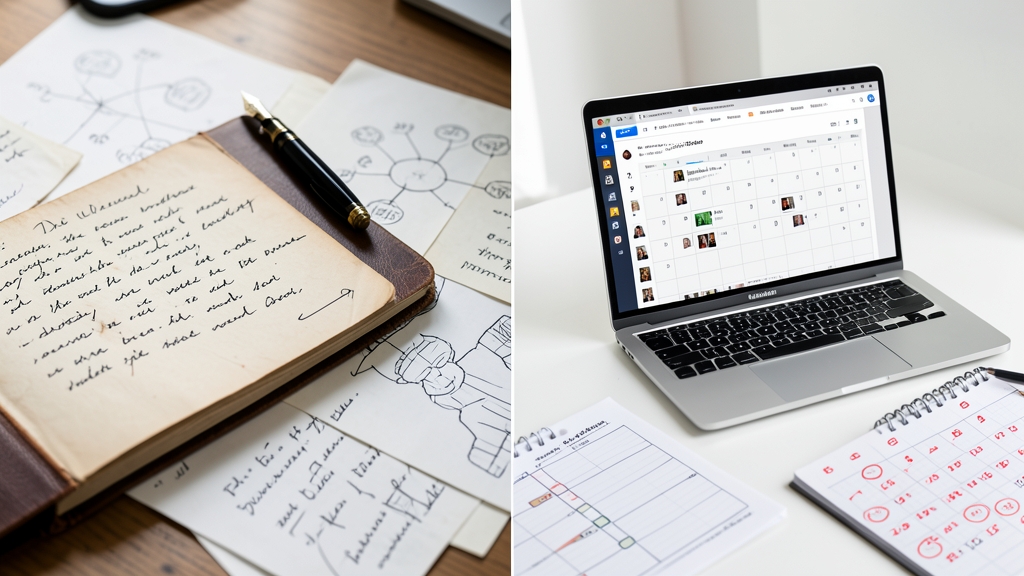
The options: content creation and content production
Content creation is where writers, designers, and creators bring their creative ideas to life [1]. One content production company describes content as something that is produced, not merely created, and considers that distinction significant [6]. Content production covers everything from setting up workflows, managing deadlines, running editing cycles, scheduling posts, and coordinating distribution across multiple channels [1]. For a business owner, these are not interchangeable terms. Creation is the act of making the asset. Production is the system that turns that asset into something published, scheduled and delivered to the right place.
The distinction matters because most small businesses conflate the two. They assume that writing a blog article is the same as having a content operation. Writing the article is creation. Building the workflow that ensures the article is edited, illustrated, scheduled and published on time is production. When a business owner understands the difference, they can see where their current process breaks down and where to direct resources.
Core focus: content creation
The focus of content creation is the idea and the asset itself. Writers, designers and creators bring their creative ideas to life at this stage [1]. Creation fuels your ideas, while production builds and realizes them, and strategy steers the direction in which your content gets seen [1]. For a small business, this is where you decide what to say, how to say it, and what form it takes: a blog article, a social post, an illustration. The quality of what comes out of this stage depends on research, writing skill and editorial judgment. If you are strong on ideas but weak on systems, this is where you will naturally spend your energy.
A business owner who enjoys writing or has a team member who does may lean heavily into creation. The risk is that creation without a production system behind it leads to inconsistent publishing, missed deadlines and assets that never reach the audience they were written for.
Core focus: content production
Production is the machinery around the asset. As described above, it covers workflows, deadlines, editing cycles, scheduling and distribution [1]. The relationship between the two stages is that creation fuels ideas, production builds and realizes them, and strategy steers the direction in which your content gets seen [1]. That distinction applies here: content is not simply created but produced, and that makes a difference [6]. For a business owner, production answers questions like who edits the draft, who checks the facts, when it publishes, where it goes, and who signs off. Without production, even a well-written article can sit in a draft folder and never reach a reader.
Production also includes the repetitive tasks that make content findable: formatting for the platform, adding images, writing metadata, scheduling social posts. These tasks are not glamorous, but they are what separate a content strategy from a pile of drafts.
Accessibility and cost: content creation
One advantage of content creation is accessibility. Platforms like YouTube, TikTok and Instagram provide accessible routes for anyone with a creative itch to share their work with a potentially huge audience [2]. The barrier to entry is low. A business owner can record a video on a phone, write a post in a text editor, or sketch an infographic without a studio, a crew or a large budget. This accessibility is why many small businesses start with content creation and treat production as something they will figure out later.
The downside of that low barrier is that anyone can do it, which means the volume of content on those platforms is enormous. Standing out requires either consistent quality, a distinct perspective, or a production system that keeps you publishing when competitors go quiet.
Accessibility and cost: content production
Traditional film and video production houses have long been the backbone of the entertainment industry, producing high-quality content for various mediums [2]. That level of production comes with trade-offs. Studio-based content carries higher cost and limited reach compared to content creator-based content [2]. For a small business, a full production approach can deliver polish and consistency but at a price that may not make sense for every piece of content. The question is not whether production is better or worse than creation in isolation, but where each one fits the budget and the goal.
A business owner does not need a film studio to benefit from production thinking. Applying production discipline to blog articles and social posts means treating each piece as part of a schedule with an editor, a deadline and a distribution plan, rather than publishing whenever inspiration strikes.
Strategic impact: content creation
If you only think in terms of content creation, you might end up with a few viral posts here and there that may grab attention for a short period of time, which is why you need a good strategic alignment to turn those efforts into long-term impact [1]. Creation without strategy tends to produce spikes of attention that fade. From an SEO perspective, original content is what earns rankings [4]. Search engines reward material that brings something new rather than material that simply repeats what already exists. Creation matters for visibility, but it needs a plan behind it to convert that visibility into something durable.
For a business owner, this means that writing good articles is necessary but not sufficient. The articles need to target searches your customers actually use, and they need a production system that publishes them consistently so search engines and readers can find them.
Strategic impact: content production
A content producer is someone who churns out material, often in response to external demands, algorithms, or trends [5]. That description carries a warning. Production that chases trends without a creative foundation can fill a calendar without building anything lasting. The relationship between content creators and traditional production companies is not necessarily adversarial but rather complementary [2]. Traditional production companies are also facing pressure, and for them it is key to adapt to the evolving landscape; while they offer expertise in storytelling, production quality and strategic planning, they must also embrace the versatility and innovation seen in content creators to remain competitive [3]. For a business owner, the takeaway is that production works best when it serves the creative work rather than replacing it.
Why understanding both matters
Creation fuels your ideas, production builds and realizes them, and strategy steers the direction in which your content gets seen [1]. The two are complementary rather than adversarial [2], and traditional production firms must adapt by embracing the versatility and innovation of content creators to stay competitive [3]. A business that invests only in creation will have ideas but no system to deliver them consistently. A business that invests only in production will have a system but nothing worth delivering.
The honest answer to which one a reader should prioritize depends on where the gap is. If you have strong ideas and no publishing workflow, production is the bottleneck. If you have a workflow but your content is generic or thin, creation is the bottleneck. Most small businesses need both, and the practical question is how to split time and budget between them. If creation is the part that keeps stalling, Why content creation is hard and how to fix it covers the usual causes, and Why content creation is worth the investment covers the case for spending on it.
For owners who want both handled without building an in-house system for each, PlainQuill researches, writes, fact-checks, illustrates and publishes SEO articles and the social posts that carry them, and nothing publishes without an approval of that exact version.
Sources
- Content Creation vs Content Production: Key Differences Explained dumplingai.com
- Content Creation vs Production: Collaboration or Competition? linkedin.com
- Content Creation vs Production: Collaboration or Competition? | LBBOnline lbbonline.com
- Content curation vs creation: your 2026 strategy guide|BM brainiacmedia.net
- Content Producer vs. Content Creator: A Philosophical Reflection - ERIC KIM erickimphotography.com
- Content Creation vs. Content Production with Brad Smith - Nick Westergaard | Author, Speaker & Educator nickwestergaard.com